What challenges do Chinese domestic automotive lighting brands face in the current global automotive lighting market?
Author: BILITEN
2025-12-15
Industry Background
1. The Global Automotive Lighting Market Landscape: The current global automotive lighting market exhibits a consolidation trend of "the big getting bigger," with leading companies consolidating their market position through mergers and acquisitions and technological upgrades. Chinese companies are accelerating their international expansion.
2. The Market Position of Chinese Domestic Automotive Lighting Brands: Market share is steadily increasing, but foreign capital remains dominant; the new energy vehicle sector has become the core growth driver; technological breakthroughs have broken the foreign monopoly, but shortcomings still exist in core areas.

Challenges Facing Chinese Automotive Lighting Brands
1. Chip Technology Barriers: Domestic automotive lighting brands are reliant on high-end light source chips. Micro LED and GaN chips have long been monopolized by Osram and Nichia Chemical.
Compared to mainstream international chips, domestic chips lag slightly behind, mainly in computing power, integration, and cost control.
2. Optical Technology Barriers: Intelligent optical systems require higher levels of R&D capabilities. Breakthroughs in luminous efficiency and brightness are a major challenge, demanding systematic breakthroughs from relevant companies in materials science, algorithm optimization, and technological innovation.

Breakthrough Directions for Chinese Automotive Lighting Brands
1. Technological Breakthroughs: Overcoming Core Technology and Standard Barriers
Increase R&D investment in cutting-edge technologies such as Micro LED, laser headlights, and ADB adaptive headlight systems to upgrade from "brightness competition" to "intelligent interaction."
Overcome the stringent requirements of automotive-grade standards, such as high and low temperature cycling (-40℃~125℃) and 1000-hour lifespan testing, to achieve product performance comparable to international giants.
2. Product Chain Integration: Achieving Full-Chain Self-Control
Extend upstream to accelerate the domestic substitution of core components such as automotive-grade LED chips and packaging materials; deepen collaborative development with OEMs downstream, participate in early-stage vehicle design, and provide customized and modular lighting solutions to meet the personalized needs of intelligent cockpits for ambient lighting, HUD backlighting, and other products.
3. Differentiated Competition: Creating Distinctive Products and Services
Leverage localized service advantages to improve response speed and after-sales capabilities, and develop adaptable products tailored to the regulations and consumer preferences of different regional markets.
Focusing on niche markets, such as the reliability requirements of the commercial vehicle lighting market and the personalization requirements of the modified vehicle market, can create a differentiated competitive advantage.

In conclusion, amidst the automotive industry's profound transformation towards intelligent and electric vehicles, the breakthrough path for Chinese automotive lighting brands is both a race of technological iteration and a testament to industrial self-reliance. Overcoming the barriers of chip and optical technologies is not an overnight process, but it has a clear direction: solidifying the core foundation through technological breakthroughs, opening up development pathways through supply chain integration, and carving out unique niches through differentiated competition.
The Rise of New Energy Vehicles Drives a New Transformation in the Automotive Lighting Industry
Recommended Well-known Chinese Automotive Lighting Manufacturers
Related Article
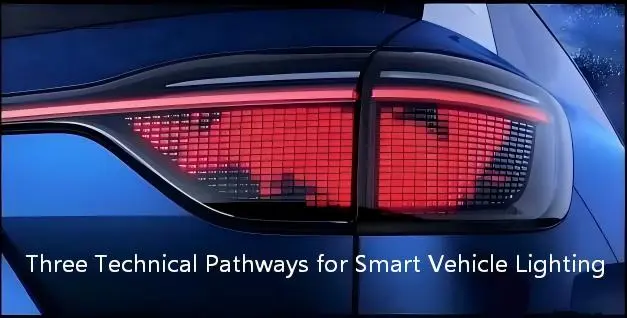
What exactly are the three technical pathways for smart vehicle lighting?
Smart Vehicle Lighting: Three Technical Pathways from "Illumination" to "Communication"
An irreversible transformation is currently unfolding within the automotive lighting industry.
The Rise of New Energy Vehicles Drives a New Transformation in the Automotive Lighting Industry