One Product for All Road Conditions—The Rationale Behind the Tri-color Fog Light Design
Author: BILITEN
2026-06-05
Introduction
Traditional fog lights typically emit a fixed, single color—either yellow or white—making it difficult to handle diverse driving conditions effectively; yellow light can appear dim in clear weather, while white light often causes glare in heavy fog. The advent of tri-color fog lights represents a key practical upgrade in automotive lighting design. By leveraging optical principles to offer three distinct settings—3000K golden yellow, 4300K neutral mixed light, and 6000K cool bright white—a single fog light can adapt to a full spectrum of scenarios, including clear skies, rain, fog, and rough rural roads.
Tri-color Fog Light are A Comprehensive Choice Derived from Physical Principles and Technological Design
Fog is a colloid composed of suspended water droplets that cause Mie scattering when light passes through. The intensity of this scattering is inversely proportional to the fourth power of the light's wavelength: shorter wavelengths scatter more strongly, while longer wavelengths scatter more weakly. Yellow light, with a wavelength of approximately 570–590 nanometers, falls within the long-wavelength region of the visible spectrum; it is least affected by scattering from water droplets, allowing it to penetrate the fog and travel greater distances.
However, if fog lights emit only yellow light, there is a risk of the "tunnel effect" occurring on clear nights; this narrows the field of vision, making it difficult to clearly distinguish blue road signs, green traffic lights, and the like. Consequently, engineers introduced the " tri-color fog lights" principle: by blending yellow and white spectral components in varying proportions, they achieve a dynamic balance between penetrative power and color rendering.

The Three Color Design Aligns with the Practicality of Daily Driving
To accommodate both rainy conditions and night driving, some vehicle owners previously opted to install two separate sets of fog lights—an approach that increased costs and consumed valuable mounting space. In contrast, conventional tri-color fog lights available on the market feature independent white and yellow LED chips within a single unit. By independently controlling power and dimming to mix the light, they deliver three distinct lighting effects from one housing, thereby saving both cost and space.
Driving needs vary significantly by region: the South experiences frequent rain and fog; the North faces dense fog and frost during autumn and winter; and high-altitude areas are often dusty yet sunny. A single color temperature cannot meet the demands of cross-regional travel. Three color fog lights break the conventional mindset that "fog lights must be yellow" by allowing the lighting output to adapt to changing environmental conditions. This solution addresses the fundamental lighting challenges posed by diverse climates and represents a mainstream trend in automotive lighting upgrades.

Summary
The tri-color fog light is a scientifically engineered product rooted in optics, human visual perception, and diverse driving scenarios. It strikes a dynamic balance between extremes and everyday conditions, penetration and clarity, and instinct and rationality, serving as an auxiliary safety light source for all-weather driving. This is a key reason why three color fog lights have become a popular market trend.
Optical Components - Prisms
Related Article
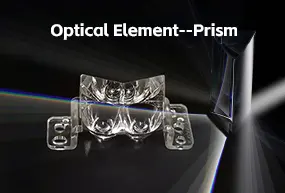
This article introduces the optical component for automotive lighting: prisms.
Optical Components - Prisms

This article introduces two common drivers for automotive lights: internal and external.
There are two most common drivers for automotive lights. Do you know them?