Optical Components - Prisms
Author: Biliten
2025-11-07
In automotive lighting design, a common method to reduce light energy loss is to use reflectors with high refractive indices. However, some loss is inevitable when the light source is refracted. Innovative designers have quietly incorporated an optical element that can significantly reduce light energy loss into their latest designs: the prism.
What is A Prism?
A prism is a transparent optical element typically used to scatter and refract light. Common materials include colorless optical glass, fluorite, quartz, and transparent plastics.

Why Do Car Headlight Designers Incorporate Prisms into Car Headlights?
The core reason headlight designers add prisms is to utilize their precise refraction, dispersion, and light-guiding properties to address the fundamental needs of vehicle illumination:
1. Optimize light uniformity and improve visual Comfort.
When LED light sources emit light directly, the light intensity is often unevenly distributed. This results in low brightness and extremely strong glare. By introducing a prism structure, the light is effectively dispersed and redistributed after multiple refractions within the prism, making the light intensity illuminating the ground or in front more uniform. This process helps eliminate localized bright spots or dark areas, reduces driver visual fatigue, and makes the lighting effect more in line with the visual comfort needs of the human eye.
2. Expand the field of view of the lighting and reduce blind spots.
Driving requires balancing the forward main field of vision and the peripheral vision on both sides. A single light source has a limited illumination range and cannot simultaneously provide adequate lighting for both the front and sides. Small prisms, through refraction at different angles, diffuse some light towards the sides of the vehicle, expanding the beam's range on both sides, reducing blind spots, and improving the driver's visibility on both sides when turning or driving at low speeds, thus enhancing driving safety.
3. Simple structure, enhanced performance
The compact prism structure allows it to be integrally molded into the internal optical components of the headlight, enabling complex light control within the limited space of the headlight. Most prism elements can directly replace the high beam cup, eliminating the need to redesign headlight components, thus reducing design costs while enhancing the optical performance of the headlights.

Besides car headlights, prisms also play a crucial role in auxiliary tools such as turn signals, brake lights, and fog lights. Turn signals utilize a multi-faceted prism structure to refract light into multi-directional warning beams, improving vehicle visibility in complex traffic environments. Brake lights employ a microprism array to enhance light penetration, allowing following vehicles to quickly perceive braking signals even in rain or fog. Fog lights, as critical lighting equipment in adverse weather conditions, use a prism-based scattering design to convert light into a wide-angle, low-brightness, uniform beam, illuminating the road ahead while avoiding blurred vision caused by light reflection, significantly improving driving safety in rain and fog.
The Development Prospects of Prisms
In the integrated development of automotive lighting and intelligent driving, prism technology shows great promise. TIR total internal reflection prisms employ a conical structure design, achieving an optical efficiency of over 90%. With the maturation of wafer-level glass forming technology, it is expected that the integrated manufacturing of aspherical-prism composite structures will be realized in the future. This will reduce the size of optical components while improving light extraction efficiency, providing a more complete technical solution for laser headlights and matrix LED systems. On the other hand, the increasing demands for environmental perception accuracy in intelligent driving systems are driving the development of prisms towards adjustable optical arrays. By dynamically deflecting the illumination angle, the light field distribution can be precisely matched with the lidar detection area, and the real-time changes in beam shape can transmit vehicle operating status, forming an intelligent light control system integrating "lighting perception and environmental interaction," thereby enhancing driving safety and supporting the realization of advanced autonomous driving functions.

Product Recommendation
The Biliten B60 and Biliten B60 PRO are two of the most typical products that replace the high beam reflector with a prism.
They use two triangular prisms joined together as a single unit. Through the special angle of the prisms, light loss during refraction is greatly reduced. The high and low beam illumination can reach 10,000 lux.
It also expands the illumination range on both sides, improving the driver's visibility when turning.

New Products are now Available for Purchase
As mentioned earlier, prisms are also used in automotive auxiliary lighting.
BILITEN's upcoming fog lights use prisms to improve brightness and illumination range.
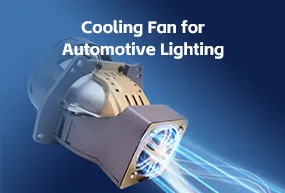
A fan is installed behind the drive cover, saving space in the headlights and improving heat dissipation efficiency.
BILITEN's upcoming fog lights use prisms to improve brightness and illumination range.
A fan is installed behind the drive cover, saving space in the headlights and improving heat dissipation efficiency.

In summary, embedding prisms inside automotive headlights is a classic solution in the field of optical engineering. With its simple physical structure and precisely calibrated design angles, it efficiently overcomes core challenges such as light distribution, uniformity, and regulatory compliance. Even today, with the widespread application of modern LED technology, this fundamental principle continues to thrive in innovative forms such as light guides, becoming an irreplaceable intellectual achievement in automotive headlight design.
One Product for All Road Conditions—The Rationale Behind the Tri-color Fog Light Design
There are two most common drivers for automotive lights. Do you know them?
Related Article
This article explains the rationale behind the creation of tri-color fog lights.
One Product for All Road Conditions—The Rationale Behind the Tri-color Fog Light Design
This article introduces two common drivers for automotive lights: internal and external.
There are two most common drivers for automotive lights. Do you know them?