Automotive Lighting Electronics: Driver
Author: Biliten
2025-09-23
Introduction: In today's rapidly evolving automotive technology landscape, attention is focused on cutting-edge areas like autonomous driving and intelligent cockpits, yet fundamental yet crucial components like headlights and their drive systems are often overlooked. Automotive headlights are the "eyes" of a car, highlighting its aesthetics and personality. They are also crucial for ensuring driving safety at night and in inclement weather. The drive system is the core behind these "eyes," ensuring their precise, stable, and efficient operation.
I. What is a Lamp Driver?
Simply put, a lamp driver (or LED driver) is an electronic control module. Its core function is to provide constant, controlled current and voltage to lamps (especially LED lamps) to ensure stable illumination.
II. The Importance of Automotive Lighting Drivers
1. Maintaining LED Stability and Lifespan: LEDs are highly sensitive to current. Even slight voltage fluctuations can cause drastic current fluctuations, resulting in unstable brightness, flickering, and even permanent damage. An excellent driver provides "pure" power to the LEDs through constant current control, significantly extending the lifespan of the LEDs.
2. Functionality: Modern automotive lights are increasingly incorporating complex functions. A classic example is adaptive high beam (ADB) headlights, which automatically adjust the lighting range and brightness using a camera to identify oncoming and preceding vehicles, as well as ambient light. This functionality relies entirely on the driver's precise and rapid control of each LED or light cluster.
3. Improving Energy Conversion: An efficient driver circuit minimizes energy loss during the conversion process, allowing more energy to be used for light generation. This contributes to lowering vehicle energy consumption and extending the range of electric vehicles.
2. Functionality: Modern automotive lights are increasingly incorporating complex functions. A classic example is adaptive high beam (ADB) headlights, which automatically adjust the lighting range and brightness using a camera to identify oncoming and preceding vehicles, as well as ambient light. This functionality relies entirely on the driver's precise and rapid control of each LED or light cluster.
3. Improving Energy Conversion: An efficient driver circuit minimizes energy loss during the conversion process, allowing more energy to be used for light generation. This contributes to lowering vehicle energy consumption and extending the range of electric vehicles.
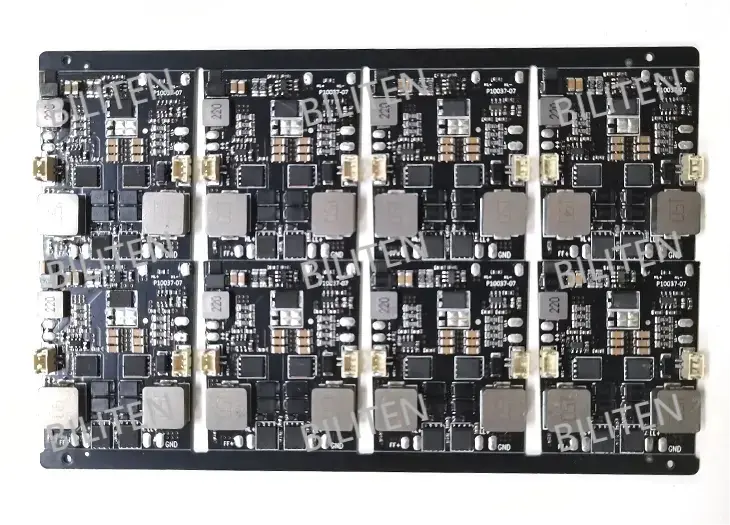
III. What are the types of Automotive Lighting Drivers?
With the evolution of headlight light source technology, drivers are also evolving:
1. Resistor-Limited Current Driver (early stage): Used for simple halogen bulbs or low-power LEDs. Its core issues are low efficiency and poor stability, and it has been eliminated as it cannot meet current needs.
2. Linear Constant Current Driver: Linear constant current drivers have the significant advantages of a simple design and low cost, but they are generally inefficient and are only suitable for scenarios where the difference between input and output voltages is small.
3. Switching Constant Current Drivers (mainstream): These offer exceptional efficiency (typically >90%), are compatible with a wide input voltage range, and cover a wide power range, from a few watts for taillights to hundreds of watts for matrix headlights.
4. Intelligent Digital Drivers (future trend): These integrate a microcontroller (MCU) and receive commands via in-vehicle networks such as CAN/LIN, enabling independent pixel-level control of each LED. This provides the foundation for advanced features such as ADB and projector headlights.
2. Linear Constant Current Driver: Linear constant current drivers have the significant advantages of a simple design and low cost, but they are generally inefficient and are only suitable for scenarios where the difference between input and output voltages is small.
3. Switching Constant Current Drivers (mainstream): These offer exceptional efficiency (typically >90%), are compatible with a wide input voltage range, and cover a wide power range, from a few watts for taillights to hundreds of watts for matrix headlights.
4. Intelligent Digital Drivers (future trend): These integrate a microcontroller (MCU) and receive commands via in-vehicle networks such as CAN/LIN, enabling independent pixel-level control of each LED. This provides the foundation for advanced features such as ADB and projector headlights.

IV. Future Trends in Automotive Lighting Drivers
Intelligence and integration are unwavering trends and pursuits in the automotive parts industry.
1. Deep Integration with Advanced Driver Assistance Systems: Automotive lights will be linked to sensors such as radar and cameras. Drivers will require lower-latency communication and more precise control to enable interactive functions such as illuminating pedestrians and projecting navigation information.
2. Higher Levels of Integration: Driver chips, protection circuits, and other components will be integrated into a single module, or even integrated with the LED light board, further saving space.
2. Higher Levels of Integration: Driver chips, protection circuits, and other components will be integrated into a single module, or even integrated with the LED light board, further saving space.
Summary
The automotive headlight driver, a seemingly inconspicuous electronic module hidden within the lamp housing, is the "brain" and "heart" of modern automotive lighting systems. It converts unstable electrical energy into precisely controllable light, continuously advancing automotive lighting from basic "visibility" to clear "clear vision" and then to advanced "intelligent vision," providing a solid barrier to safety on every night trip. In the future's smarter, more connected automotive ecosystem, its core role will become even more critical.
There are two most common drivers for automotive lights. Do you know them?
Cooling Fan for Automotive Lighting
Related Article
This article explains the rationale behind the creation of tri-color fog lights.
One Product for All Road Conditions—The Rationale Behind the Tri-color Fog Light Design
This article introduces the optical component for automotive lighting: prisms.
Optical Components - Prisms